Transit media advertising in Dubai: complete 2026 cost guide covering Metro, taxi, bus, tram, airport, ferry & fleet formats. Rates from AED 3,500 (taxi interior) to AED 220,000+ (Metro train wrap).
DOOH vs Traditional Billboards: Which Delivers Better ROI?
Summary:
Compare DOOH digital screens vs static billboards in Dubai. Cost, targeting, flexibility & performance. Make the right choice for your brand.
March 09, 2026
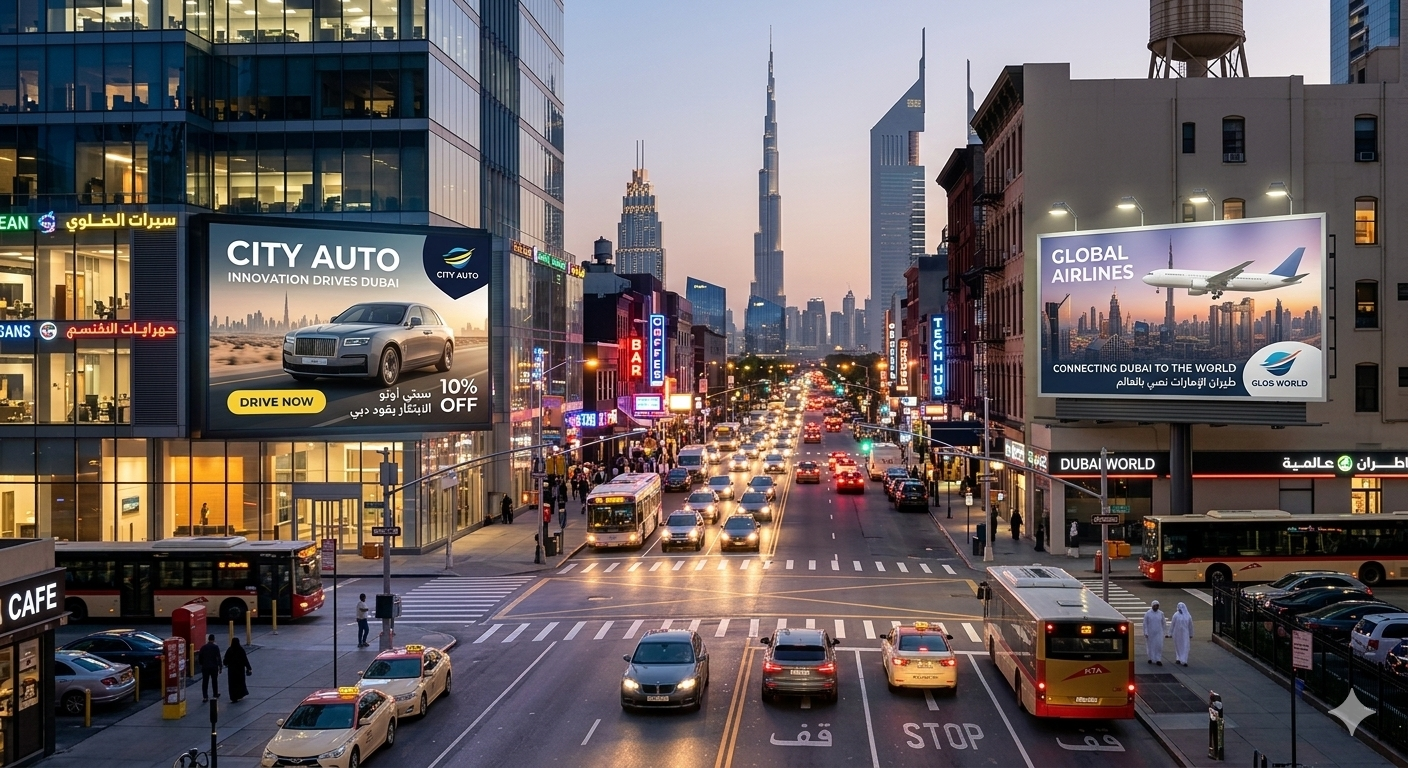
Every marketing budget conversation in Dubai eventually arrives at the same crossroads: do you go with a traditional static billboard that owns its location 24 hours a day, or do you invest in a Digital Out-of-Home screen that rotates your ad among multiple brands with dynamic, real-time creative capability? It sounds like a simple either-or question. In reality, it is one of the most nuanced decisions in outdoor advertising — and the answer genuinely depends on your campaign objective, your budget structure, your audience, and how you define return on investment.
This blog breaks down both formats honestly. We are going to look at how each works, what each costs, how ROI is calculated for both, where each one wins, where each one falls short, and what the smartest brands in Dubai are doing in 2026 to get the most out of their outdoor advertising spend. Whether you are running your first billboard advertising campaign in Dubai or you are a seasoned marketing director evaluating a mid-year media plan, this is the comparison you need.
What Is DOOH Advertising and How Does It Differ from Traditional Billboards?
Let us start with the basics, because the terminology matters when you are making a buying decision.
A traditional static billboard — also called an OOH (Out-of-Home) billboard — is a fixed printed panel on a structure. Your artwork is physically printed on vinyl or applied as a large-format print, and it occupies the panel 100% of the time for the duration of your booking. Nobody else's ad runs on that panel while you are paying for it. The billboard is yours, exclusively, around the clock.
DOOH stands for Digital Out-of-Home advertising. These are LED or LCD digital screens installed in outdoor locations — on roadsides, in shopping malls, at petrol stations, in elevators, metro stations, hotel lobbies, and across Dubai's major highways — that display a rotating loop of multiple advertisers' content. Your ad appears on screen for a set duration within each rotation cycle, typically 10 to 15 seconds per loop. The screen is shared between multiple brands simultaneously across a 24-hour period.
Both formats fall under the broader umbrella of outdoor advertising, and both can be enormously effective. But they work differently, serve different strategic purposes, and produce different ROI profiles depending on how and where they are deployed.
How ROI Is Measured in Outdoor Advertising
Before comparing the two formats directly, it is worth establishing a shared understanding of how ROI is measured in outdoor advertising, because this is an area where many advertisers get confused.
The most commonly used metric in outdoor advertising is CPM — cost per thousand impressions. This measures how much you are paying for every 1,000 pairs of eyes that pass your advertisement. It is calculated by dividing the total campaign cost by the estimated audience impressions and multiplying by 1,000.
Beyond raw CPM, sophisticated advertisers also evaluate outdoor advertising ROI through brand recall lift — measured through pre and post-campaign surveys — sales volume or enquiry volume uplift during and after campaign periods, website traffic increases tied to campaign geography and timing, and the halo effect on other marketing channels like paid search and social media that perform better when an outdoor campaign is simultaneously running.
Both traditional billboards and DOOH can deliver strong ROI. The question is which delivers stronger ROI for your specific objective and budget — and that answer changes depending on the campaign type.
Traditional Static Billboards: Where They Win
100% Share of Voice — All Day, Every Day
This is the single most powerful advantage of a traditional static billboard, and it is one that gets underestimated in the excitement around digital formats. When you book a traditional billboard, that panel belongs to you completely for the duration of your campaign. Your ad is visible at 7am during morning rush hour, at 2pm, at 8pm during the evening commute, and at 3am when a night-shift worker drives past. Nobody shares it. Nobody rotates your ad off screen. The message is permanent and continuous.
This exclusivity is enormously valuable for brand awareness campaigns that depend on frequency. The more times a person sees your brand message, the more deeply it registers in their memory. A driver who commutes along the same road every working day and passes your billboard twice daily accumulates dozens of exposures over a one-month campaign period. That kind of consistent, repeated, uninterrupted exposure is the foundation of strong brand recall — and it is something DOOH simply cannot replicate at the same level, because your ad only occupies the screen for a fraction of each hour.
Longer Dwell Time and Dominant Presence
Static billboards have an inherent permanence that shapes how they are perceived. A large, well-placed traditional billboard on Sheikh Zayed Road or in Business Bay is a physical landmark. Passers-by see it not just as an ad but as a marker in the urban landscape. Brands that run long-term static billboard campaigns in premium locations become visually associated with those locations, which is a powerful form of place-based brand equity that is difficult to put a number on but very real in consumer psychology.
Lower Entry Cost and Simple Execution
For businesses operating with tighter marketing budgets or those running their first outdoor advertising campaign, traditional static billboards offer a simpler, more cost-predictable entry point. The pricing model is straightforward — you pay a set fee for a set duration, your artwork is printed and installed, and the campaign runs. There are no programmatic complexities, no minimum slot purchase requirements, and no creative adaptation needed for multiple screen formats.
For brands using supporting formats like building wraps, hoardings, or wallscapes, the same static production approach applies — one piece of artwork, produced to specification, installed and left to work.
Best Use Cases for Traditional Billboards
Static billboards consistently deliver the strongest ROI for long-term brand awareness campaigns of one month or more, campaigns with a single core message that does not need to change, location-dominant strategies where owning a specific landmark placement is part of the brand statement, and budgets where maximising frequency on a smaller number of premium sites outweighs the flexibility of running across many DOOH screens.
DOOH Advertising: Where It Wins
Creative Flexibility and Real-Time Updates
The most obvious advantage DOOH has over static formats is creative flexibility. Because the content is digital, it can be changed almost instantly — without any printing, installation, or physical logistics. A brand running a DOOH campaign in Dubai can update creative for different times of day, respond to breaking news or real-time events, rotate multiple messages within the same campaign to avoid creative fatigue, and localise content for different screens in different zones simultaneously.
This flexibility has tangible ROI implications. For retail brands running promotional campaigns, the ability to update pricing or offers in real time without reprinting costs is a genuine operational advantage. For event-based campaigns with specific dates, the ability to count down or dynamically reference the event as it approaches creates a level of immediacy that static cannot match.
DataMySite's DOOH advertising solutions in Dubai include digital unipoles along major highways and petrol station digital screens — formats that place your dynamic content exactly where high-dwell-time audiences are present. A driver stopped to refuel at a petrol station is stationary for three to five minutes, making the petrol station screen one of the highest-attention DOOH environments in Dubai's outdoor media landscape.
Network Reach Across Multiple Locations
A single DOOH buy in Dubai can place your brand simultaneously across a network of screens spanning multiple zones, districts, and venue types. Rather than committing your entire budget to owning one premium static site, a DOOH network buy can distribute your creative across dozens of screens — in Business Bay office towers, Dubai Marina pedestrian areas, hotel lobbies, metro station concourses, and major highway corridors — all under a single campaign booking.
This multi-location distribution creates a surround-sound effect that single-site static campaigns cannot achieve. Audiences encounter the brand at multiple touchpoints throughout their day, which builds recognition and frequency through cumulative exposure rather than repeated exposure at a single point. For brands looking to create the impression of market-wide presence — particularly at launch moments or during competitive periods — DOOH network buys are among the most efficient tools available.
Programmatic Targeting and Dayparting
One of DOOH's most sophisticated ROI advantages is programmatic delivery — the ability to schedule when your ad appears based on time of day, weather conditions, audience demographic data tied to location, and even live event triggers. This is a capability that simply does not exist in traditional static advertising.
Consider a food delivery brand that wants to show its ad only during lunch and dinner hours when appetite-driven decisions are being made. Or a luxury automotive brand that wants its creative to run only on premium highway screens in Business Bay between 8am and 10am when decision-maker commuters are at peak volume. These targeting capabilities dramatically improve the relevance of each impression — and more relevant impressions translate directly to better ROI.
Pairing DOOH with social media marketing creates a particularly powerful combination. Audiences who encounter your brand on a DOOH screen in a specific location can be retargeted with aligned social content, creating a consistent brand narrative that follows the consumer from the street to their phone and drives measurable conversions through the digital layer.
Best Use Cases for DOOH
DOOH advertising delivers its strongest ROI for time-sensitive promotions and campaigns with changing messages, brands that need multi-location presence across multiple audience segments simultaneously, campaigns that benefit from dayparting or programmatic audience targeting, product launches requiring rapid, city-wide brand saturation, and campaigns designed to be integrated with digital retargeting via lead generation or social media amplification.
Head-to-Head ROI Comparison: The Honest Breakdown
| Factor | Traditional Static Billboard | DOOH Advertising |
|---|---|---|
| Share of Voice | 100% — exclusive panel ownership | Shared — typically 4–6 advertisers per screen |
| Creative Flexibility | Fixed — change requires reprint | Instant — update in real time |
| Frequency per Viewer | Very high — same audience sees it repeatedly | Moderate — depends on loop frequency and location |
| Network Reach | Single location per booking | Multi-location across one campaign |
| Targeting Capability | Location and audience segment | Location, time of day, weather, programmatic |
| Production Cost | Print + installation per change | No physical production cost for updates |
| Entry Budget | Lower — accessible for SMEs | Moderate to higher depending on network |
| Best For | Long-term brand awareness | Dynamic, flexible, multi-touchpoint campaigns |
| Measurability | Impressions-based estimation | Data-rich with audience analytics |
| Premium Location Ownership | Yes — you own the spot entirely | No — shared rotational placement |
The ROI Verdict: Which Is Better for Dubai Brands in 2026?
Here is the honest answer that most agencies will not give you: neither format is universally better. The format that delivers better ROI is the one that is better matched to your specific campaign objective, audience, and budget structure.
If you are a real estate developer launching a new project and you want to own a landmark billboard on Sheikh Zayed Road for three months, building deep familiarity and premium brand perception with every commuter who passes — static billboard advertising wins on ROI for that objective.
If you are a retail brand running a seasonal sale and you need to update your creative weekly across Business Bay, Dubai Marina, and Downtown simultaneously while retargeting digital audiences who encounter your ads — DOOH wins on ROI for that objective.
If you are a brand with a significant budget and ambitions to dominate Dubai's visual landscape across multiple touchpoints — the answer is not a choice between the two. It is both. The smartest campaigns in Dubai combine the sustained frequency of traditional billboard advertising at landmark locations with the flexibility and reach of DOOH across a supporting network, amplified further by transit media like taxi advertising and metro advertising that keeps the brand visible throughout the audience's entire daily journey.
The multiplication effect of combined outdoor formats consistently outperforms either channel in isolation, and it is the approach that Dubai's most visible brands reliably use to maintain market dominance year after year.
How DataMySite Plans Your Outdoor Campaign for Maximum ROI
At DataMySite, we do not sell formats — we engineer outdoor advertising strategies. Our process begins with your objective and works backwards to identify the optimal combination of formats, locations, budgets, and campaign durations to deliver the strongest possible return.
For brands considering billboard advertising in Dubai, our team conducts a detailed location analysis, competitive landscape review, and audience mapping before making any placement recommendation. We apply the same rigour to DOOH planning — assessing network coverage, loop frequencies, dayparting opportunities, and creative specifications to ensure every element of the campaign is built to perform.
Whether your objective is mass-market brand awareness, a precise product launch, long-term market dominance, or a short-burst promotional campaign, DataMySite builds the plan around your goals — not around the format we happen to have inventory for.
Contact DataMySite today for a free outdoor advertising consultation and let us show you exactly which combination of formats will deliver the best ROI for your brand in Dubai's outdoor media market in 2026.
Related Articles
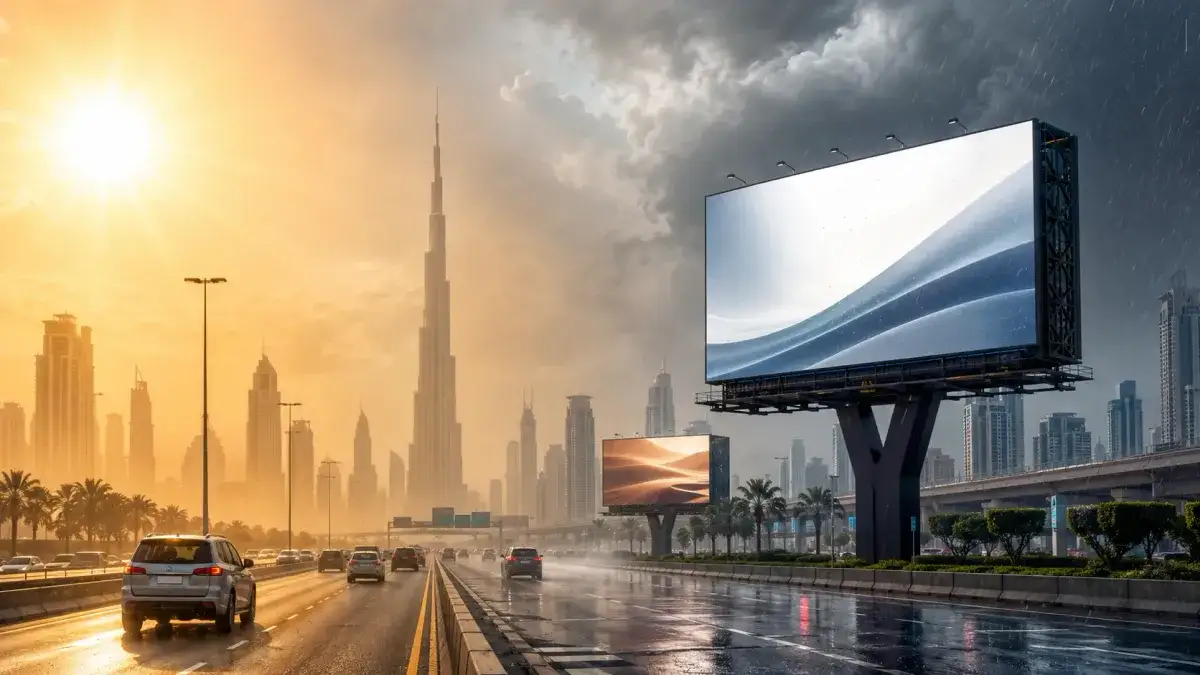
Transit Media Advertising Dubai — Complete Cost Guide 2026
Published On - October 12, 2026
Bridge Banner Advertising Dubai — Costs, Locations & Campaign Guide 2026
Published On - October 12, 2026
Bridge banner advertising in Dubai starts from AED 25,000/month. Complete guide to prime bridge locations (Al Safa, Business Bay), format sizes, permit requirements, and 2026 rates.
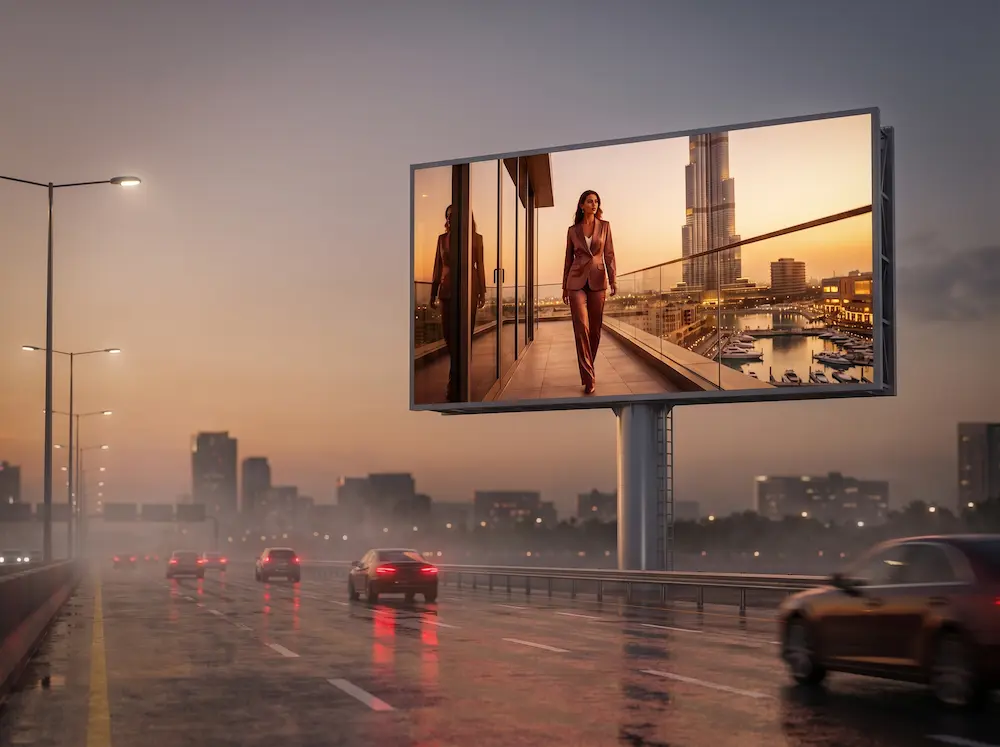
Unipole Advertising Dubai — Sheikh Zayed Road Billboard Rates 2026
Published On - October 12, 2026
Unipole advertising in Dubai starts from AED 45,000/month. Complete guide to SZR unipole rates (AED 75,000–220,000), prime highway locations, digital vs static, and booking process 2026.




Before You Leave
Get a Free Strategy
From Dubai's Top Ad Agency
Our experts respond in 60 min — no commitment, no cost.
D
Ava · datamysite
Usually replies instantly
Powered by Claude · DataMySite