Transit media advertising in Dubai: complete 2026 cost guide covering Metro, taxi, bus, tram, airport, ferry & fleet formats. Rates from AED 3,500 (taxi interior) to AED 220,000+ (Metro train wrap).
How Much Does Elevator Advertising Really Cost in Dubai?
Summary:
A clear 2026 breakdown of elevator advertising costs in Dubai by venue type, plus what drives pricing and who this captive-audience format suits.
July 20, 2026
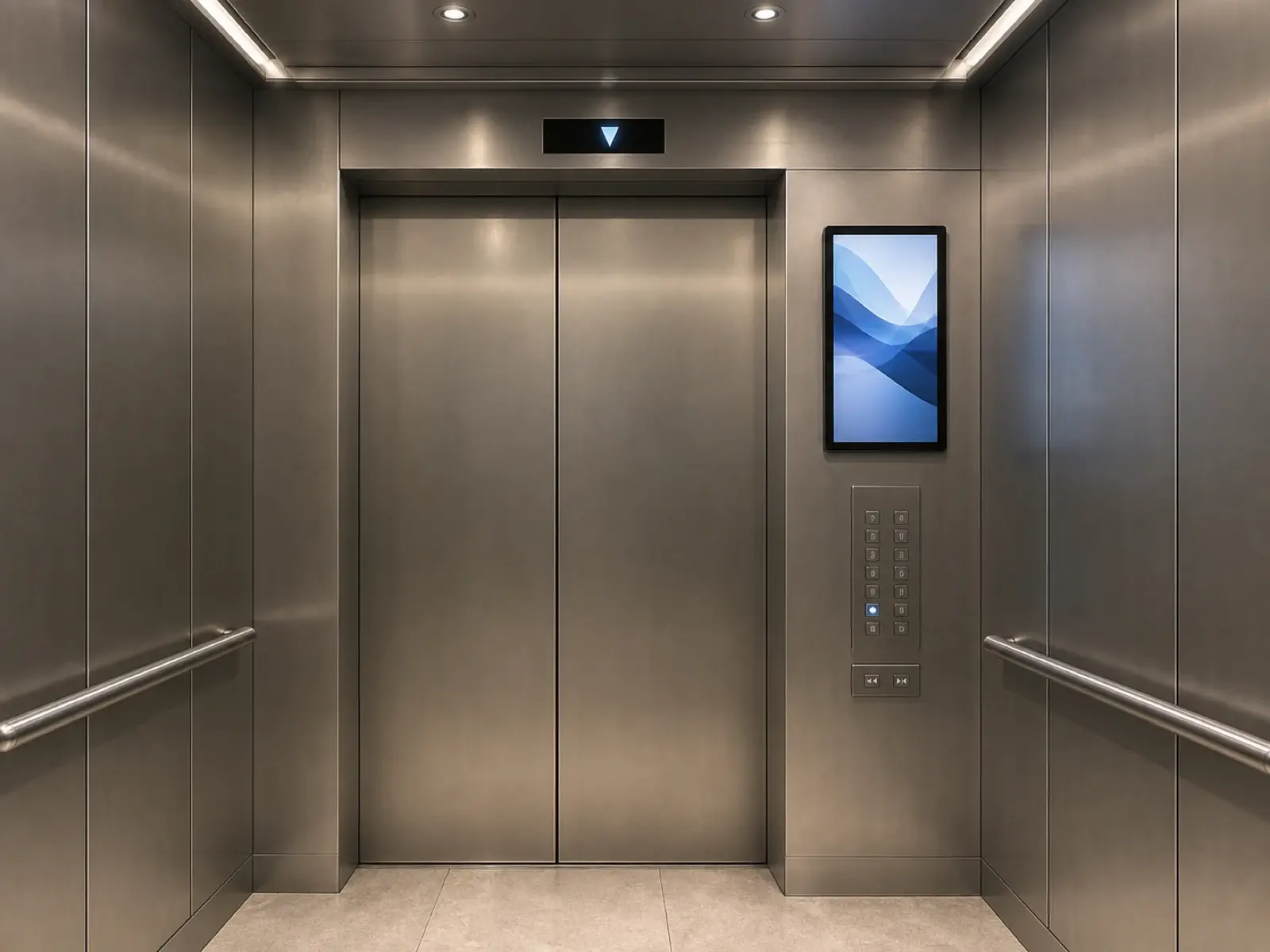
Elevator advertising is one of the most underrated formats in Dubai. It puts your brand directly in front of a captive audience — office workers, residents, shoppers and hotel guests — during a moment when there's nothing else to look at. That undivided attention is exactly what makes it effective. But how much does it actually cost? Here's an honest 2026 breakdown.
What you're paying for
Elevator advertising places static or digital ads inside elevator cabins, in the lobbies beside them, and at the vertical circulation points of high-footfall buildings. You're buying dwell-time attention: the average person spends a captive minute or two in and around a lift, with no phone signal in some buildings and nothing competing for their eyes. That's a rare quality in advertising, and it's why the format punches above its price.
Elevator advertising costs by venue type
Pricing varies mostly by where the building is and what audience it holds. Typical 2026 monthly market ranges:
- Residential & mixed-use towers: static ads inside lifts around AED 1,500–6,000; digital lobby screens roughly AED 3,000–12,000.
- Malls & retail complexes: static panels around AED 3,500–12,000; digital and LED screens roughly AED 6,000–22,000.
- Hotels & hospitality: static ads around AED 3,000–9,000; premium digital screens up to about AED 20,000.
- Transit-connected locations: Metro and transit lobby screens roughly AED 6,000–25,000.
Production, printing and installation are usually quoted separately, and exact rates depend on the specific building, screen type, duration and how prominent the placement is.
What drives the price up or down
Three factors move elevator pricing more than any other:
- Location and audience: a lift in a DIFC corporate tower or a luxury residential building commands more than one in a secondary area, because the audience is more valuable.
- Format: static panels are the most affordable; digital and interactive screens cost more but let you rotate multiple messages.
- Building occupancy and duration: high-traffic buildings cost more, while longer bookings usually earn better monthly rates.
Who elevator advertising suits
This format is ideal for brands that want to reach a specific, defined audience rather than the whole city. A B2B software company can target DIFC office towers; a family restaurant can target residential buildings in its delivery radius; a luxury brand can target five-star hotels. Because you're buying by building, you can align the audience of the lift with the audience of your product with real precision — something mass formats can't offer.
How to get the most from your budget
Keep the message short and instantly readable — a lift ad is glanced at, not studied. Choose buildings by audience match, not just footfall; a smaller number of well-matched towers beats a scattergun spread. Consider digital screens where you want to run several offers or refresh creative during the campaign. And bundle elevator ads with a complementary channel — it pairs naturally with billboards, transit or radio to build recall across the day. Wherever possible, request occupancy and footfall data so you can estimate impressions and measure the campaign against them.
The bottom line
Elevator advertising is one of the most cost-effective ways to buy genuine, undivided attention in Dubai, with entry points low enough for small businesses and premium placements strong enough for luxury brands. The key is matching the buildings to your audience and keeping the creative sharp.
Static panels vs digital screens
Within elevator advertising, the static-versus-digital choice shapes both budget and capability. Static panels are the most affordable and perfectly effective for a single, consistent message — ideal for brand awareness or a steady offer. Digital screens cost more but let you rotate several messages, refresh creative mid-campaign, and use motion to catch the eye. For a small business promoting one service, static is usually the smart, economical choice; for a brand running multiple offers or wanting a premium feel in a luxury tower, digital earns its higher rate.
How to measure an elevator campaign
Like all out-of-home media, elevator advertising needs measurement built in before launch. Use a QR code on the panel linking to a dedicated landing page, a promo code exclusive to the campaign, or a specific offer that only appears in those buildings. Ask your media partner for the occupancy and footfall figures of each building so you can estimate impressions and judge cost-per-thousand. And watch for lifts in branded search and direct enquiries during the campaign. Because you're advertising to a defined set of buildings, elevator campaigns are actually easier to isolate and measure than city-wide formats.
Why the captive audience matters so much
It's worth dwelling on what makes elevator advertising genuinely different. In almost every other advertising moment, you're competing for attention against phones, conversations, traffic and a hundred other distractions. In a lift, there's a rare pause — a captive minute where people naturally look for something to read. That undivided, low-distraction attention is exactly the environment brands pay premiums for elsewhere, and elevator advertising delivers it at a fraction of the cost. For the right audience match, few formats offer this quality of attention per dirham spent.
To sum up: elevator advertising is a targeted, high-attention format that suits almost any brand willing to think in terms of audience rather than sheer scale. Whether you're a B2B firm aiming at corporate towers, a local service targeting nearby residential buildings, or a luxury brand seeking five-star hotels, the format lets you match your placements precisely to the people you want to reach — and it does so at entry points low enough for small businesses and quality high enough for premium brands. Choose your buildings by audience fit, keep the creative sharp and instantly readable, and build measurement in from the start. Get those basics right and elevator advertising delivers some of the best attention-per-dirham available anywhere in Dubai.
It is also worth remembering that elevator advertising compounds through repetition, just like other outdoor formats. The same residents, office workers or shoppers pass the same panels every single day, often several times, which means your message is reinforced continuously over the course of a campaign. That daily, unavoidable repetition — in a setting where the audience has nothing else to look at — is precisely what builds the strong brand recall that turns awareness into enquiries over time.
Want to know exactly what a campaign in your target buildings would cost? Explore our elevator advertising services in Dubai for a tailored quote.
Related Articles
Transit Media Advertising Dubai — Complete Cost Guide 2026
Published On - October 01, 2026
Bridge Banner Advertising Dubai — Costs, Locations & Campaign Guide 2026
Published On - October 01, 2026
Bridge banner advertising in Dubai starts from AED 25,000/month. Complete guide to prime bridge locations (Al Safa, Business Bay), format sizes, permit requirements, and 2026 rates.
Unipole Advertising Dubai — Sheikh Zayed Road Billboard Rates 2026
Published On - October 01, 2026
Unipole advertising in Dubai starts from AED 45,000/month. Complete guide to SZR unipole rates (AED 75,000–220,000), prime highway locations, digital vs static, and booking process 2026.




Before You Leave
Get a Free Strategy
From Dubai's Top Ad Agency
Our experts respond in 60 min — no commitment, no cost.
D
Ava · datamysite
Usually replies instantly
Powered by Claude · DataMySite